

Episode 10: Homesick
In which Alessandra finds there's no place like home

Alessandra takes a photo of Ralph, and makes flyers and posts them around the village, but no one responds, and she finds herself hoping no one will. He is, for the time being, her dog.
The building renovations take shockingly little time. (It seems to be an unwritten rule that contractors must exceed their estimated time by a month or two or twenty-two.) It helps that there’s very little that needs doing to restore the building to its former glory as a restaurant.
By early July, the restaurant is ready to open.
In preparation for her new role, Alessandra reads Omnivore’s Dilemma and In Defense of Food, and decides to run an organic vegetarian restaurant. Notably, she does not read any cookbooks. Nor does she consult with—or even talk to—the island’s resident gourmet chef.
Gloria would have been glad to help (competition isn’t something you worry about when you serve the best food known to man- or woman-kind, and you run the only “fancy” restaurant on the island). But Alessandra is certain she can do this thing, and just as certain it is temporary, so why go to the trouble of learning to cook?
The islanders are the poorer for her certainty.
Ralph sleeps in the bed with Alessandra every night. The last thing she sees before drifting to sleep are his warm and slightly worried eyes; the first thing that greets her in the morning are the hopeful ministrations of his tongue. Ralph personifies joy—fierce, purposeful joy, and that joy is just a little bit contagious. Breakfast and suppertime are revelations. Walks delight him. A casual pat on the belly makes him swoon with happiness.
Every day Alessandra gets up, walks Ralph, sits in companionable silence with her parents and her ready-made coffee, and then heads to the restaurant, with Ralph in tow. Every day she thinks what a nice interlude this is, something to fill the time until she’s ready to leave the womb again.
That’s how she puts it to Ralph on their way to work. “This is a nice interlude,” she says, “until I’m ready to leave the womb again.”
Ralph looks at her with unabashed adoration, and wags his tail. Alessandra reads in his tail-wag that she is a brilliant conversationalist, or she’s made the right decision to work for Cody, or both.
At the restaurant, Alessandra makes omelets with local free range eggs and organic peppers and onions, and organic home fries. It all sounds good on paper but the reality is almost inedible. She is overly-mindful of her budget, and the fact that the American diet contains far too much fat and salt, so she serves dry potato chunks, and overcooked eggs, with no salt or seasoning of any kind on either eggs or potatoes.
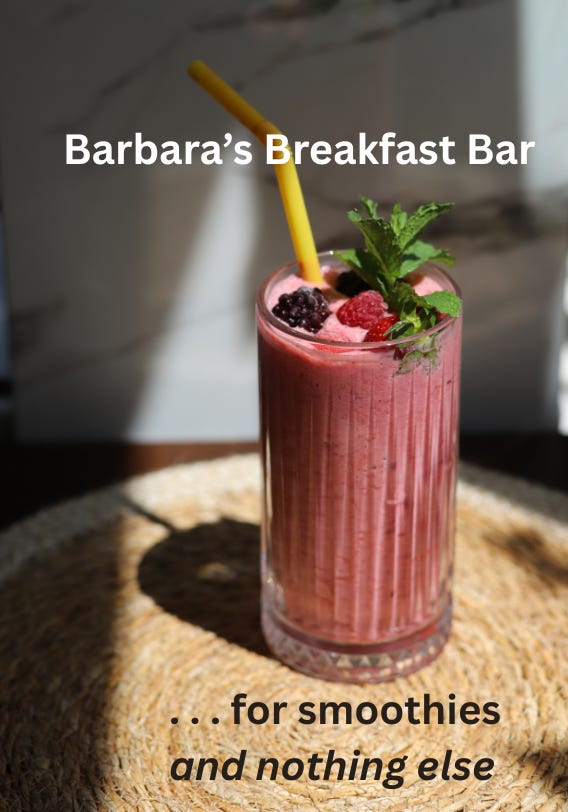
No one ever complains to Alessandra directly—that wouldn’t be the Looser Island way—and they keep coming back because, quite by accident, she makes the world’s best fresh fruit and yogurt smoothies. The secret is blackberry honey, and a splash of real Mexican vanilla.
Unfortunately, customers are not allowed to buy only a smoothie. Alessandra is unaware that a restaurateur who places unreasonable demands upon her customers will soon find herself out of business, and the menu simply states that when ordering a meal customers may choose one of two in-season smoothies. Occasionally, someone tries to order a smoothie without the entrée, to which Alessandra responds if that was an option it would be on the menu.
So people come in and order unseasoned oil-free home fries and chokingly dry house-made whole-grain salt-free bread and flavorless omelets and soups, and enjoy their smoothies and pat Ralph and quietly toss the rest of the meal in the garbage. (Alessandra’s wisely asked customers to refrain from giving Ralph their leftovers, otherwise sausage-dog won’t just be a nickname for this Dachshund! she says.)
The place is almost never busy, the restaurant is only open for breakfast and lunch Wednesday through Sunday, and the dining area is tiny, seating a maximum of twenty. As a result, Alessandra is able to run it without any help. She says vaguely, from time to time, that when business picks up she will hire more staff. In the meantime, Alessandra’s friends—the people she knew from high school and who, inexplicably to Alessandra’s way of thinking, never left the island—hang out in the restaurant and pitch in on those rare occasions when there is a “rush” i.e. more than a few customers.
The rest of the time the friends sit around and talk of grand theosophies and baggy pants, debate whether German chocolate is superior to Belgian, and play at hooking up but never seriously. These twenty-somethings aren’t looking for commitment, and besides, no one wants to risk the sweet, sweet cup of friendship they’ve nurtured for so long.
Cody-from-Seattle continues to check in sporadically, and reminds Alessandra that she needs to choose a name for the restaurant, which still bears the sign THE FLOWER SHACK over the door. The business name on the credit card is CBO LLC, short for Cody’s Business Operations, he says. Of which there are many, he adds, intimating that whether this particular business succeeds or fails is of minimal importance to him. However, he says, the restaurant still needs a DBA.
After a quick search on the internet, Alessandra figures out that DBA stands for doing business as, and she likes the concept, the suggestion that a business can remake itself to fit its name. She, Alessandra, is doing business as a restaurant manager. Alessandra dba Looser Islander, at least until she can find a way to be a Defender of Mankind, befitting the etymology of her name.
She believes herself to be a reasonably creative spirit, but she comes up blank every time she thinks about a new name, so she turns it into a contest among her friends, offering free smoothies for a week, or the part of the week the restaurant’s open anyway, to whoever comes up with a good name.
Her friends Jade and Cassie and Dominic show up the next day, more than a little high, and start playing with words that sit happily in their befuddled brains: Revelation Restaurant, Alessandra’s Aerie, Sassy Smoothies, Island Itinerant Eatery. For reasons no one can ever afterward remember, other than the pleasing alliteration, they settle on Barbara’s Breakfast Bar, even though there has never been anyone named Barbara connected with the building, the restaurant serves lunch as well as breakfast, and the place is neither a bar in the sense of serving alcoholic drinks nor does it have a traditional diner’s bar or counter for sitting at.
In August, Ella and Markus and Jim Perkins come in with a man who speaks English haltingly. With only time for a quick glance from the kitchen, Alessandra places the man as Latino, but when she emerges and takes their order she realizes that isn’t right, and then she feels an unexpected pang of longing, a frustrated hope that he would speak to her in Spanish, and resurrect for her the arid cliffs and bright adobe of her Change Now! days.
(He’s from Syria, she later learns, and she is alternately offended on Pelabo’s behalf and gratified at the familiar syllables of “Paulo,” after Jens Jensen renames the poor man.)
It’s just as well, right? she says to her friends. She left Change Now! and the tiny pueblo for a reason, she says. Right?
As good friends will, they nod, even if they privately believe she’s a little flaky and should really figure out what it is she wants to do and then just do it, for god’s sake.
In spite of her assurances that she can handle basic financial records, Alessandra is never quite certain the restaurant is making money. She dutifully records income and expenses, and regularly deposits the revenues into the bank, but she has no knowledge of the expenses Cody’s handling—the cost of the renovations, payroll taxes and workers’ compensation premiums and unemployment taxes, franchise taxes, utilities, etc. Every two weeks a paycheck arrives in the mail, and the company credit card continues to cover the basic costs for which she’s responsible, so she assumes her work must be satisfactory.
Anyway, it’s only temporary. If Cody comes back and fires her for doing a poor job, well, then, that will be her sign it’s time to move on.
In October, a few months after what is now known as Barbara’s Breakfast Bar opened and earned a reputation as the place to go for smoothies and nothing else, Alessandra’s parents receive a letter from a lawyer in Italy stating that Alessandra’s grandfather has died. Grandfather Otis lived just outside Siena, in Italy, where he ran a sizeable vineyard and olive orchard. He had refused to speak to his daughter (Alessandra’s mother), though she was his only offspring, after she married an American, but now he is dead, and he’s left everything to the granddaughter he never met.
“This is your chance,” Jade says.
“You’ve been waiting for an excuse to escape again,” Cassie says. “Here it is.”
“Your parents don’t even like to travel,” Dominic points out. “They haven’t, like, left the island in, like, eons. Except for, you know, doctor’s appointments and shit.”
“And when you graduated from college,” Cassie adds.
“You should go,” they tell her.
Their words surprise an unexpected ambivalence in her. They’re giving voice to what she believes she wants, but just now, suddenly, she’s not so sure.
After consulting with postmistress Jenny (who advised her to listen to the wind, the spirit of mother earth will show her the way), she decides the universe must be trying to tell her it’s time to go.
And she’d be a fool to ignore the universe, right?
Which is why, at the age of not quite twenty-six, having had the good fortune to have her destiny land in her lap (with apologies to the warm circle of dog that is actually sitting in her lap), she decides to leap into the abyss.
Again.
Alessandra grapples with the question of who will keep Ralph after she moves to Italy.
Jim Perkins seems like a kindly soul, but what if Rambo thinks Ralph looks like an appetizer? Gloria already has more dog than she can handle. Shelby at the Apple Cart would probably at least tolerate Ralph, but no one in their right mind asks Lauren for a favor. Ditto Retha at Retha’s Bar & Grill.
Cecelia Prewitt has had no dog since her beloved Pug, Hubert, passed away, but what if she dies right after Alessandra leaves?
(Alessandra, like many young adults, believes or suspects anyone over sixty is likely facing imminent demise.)
Ultimately she takes the easy way out, and asks her parents, who say they’ll be glad to keep Ralph. She hears in her mother’s answer a hope that her daughter will return, will not leave her parents and her dog forever, but Alessandra is too focused on her own misgivings to answer her mother’s.
She gives Cody the required two week notice, and then undergoes a few “lasts,” including serving her last round of customers, after which she locks the restaurant, and puts the key under the mat.
She says goodbye to her friends (who changed their minds after she announced she was taking their advice, and tried to convince her to stay), gets a ride to the ferry landing, from whence she will walk on the ferry, then take a shuttle to the airport, and then catch a plane to another continent.
She feels like she’s in a movie, standing at the stern of the ferry watching Looser Island slip into the fog behind her.
Is this what it’s supposed to feel like, fulfilling your destiny?
She endures fifteen hours of flying and transferring and flying again, gets airsick (where did that come from?—she must be getting old, she thinks), and then makes her way to her pension in Florence, which she’d identified through a combination of internet searching and conversations with her mother. The pension is near the train station, so she’ll be able to travel easily to and from Siena, where her grandfather’s vineyards are.
And then she dives headfirst into the business of transforming herself into an Italian.
There is much to learn.
First, she realizes, she must learn to avoid being run down by a moped in the narrow-cobbled alleyways that pass for streets.
Then, she must learn never to look at the brightly colored scarves and leather goods for sale in the open-air markets. Even a casual glance results in the young merchant following her down the street, wheedling and cajoling, offering to make her a deal (and sex, if she’s interested).
She must learn how to cook the rabbits stretched out, skinless but in every other aspect intact, at the meat counter. (Maybe the Looser Islanders should learn to cook rabbit?)
Though her mother took pains to teach her some Italian as a child, and many Italians speak passable English, she must improve her Italian language skills.
She must learn to like Gorgonzola cheese.
The minutes melt into hours melt into days, and with each passing moment Alessandra reminds herself how lucky she is to have left the stultifying atmosphere of going nowhere on a remote island in the Salish Sea.
Once, she hears a Dachshund barking at a pigeon picking its way across Piazza San Marco. For the second time in her life, Alessandra feels her heart break.
But she knows she must be strong. Surely this is the place where she will finally fulfill the promise of her name.
Sometimes, the musical babble of Italian, mingled here and there with Spanish (O Spanish!), gently disdainful French, clanging American English, and whimsical British accents threatens to overwhelm her, to sweep her away in a sea of voices, and she longs for the cacophony of seagulls. The gulls only speak one language, as far as she knows.
The remedy for nostalgia is time in her grandfather’s vineyard, she believes, and she will be back in the vineyard in a few days, she reminds herself, so that’s all right.
Letters from home keep her updated, and she hears with unexpected sadness that ICE showed up and Paulo née Pelabo ran away. At least, everyone hopes he ran away.
And then she thinks: What if she’d offered him a job at Barbara’s Breakfast Bar? Unlike the Apple Cart, the restaurant isn’t in the village, isn’t so exposed to visitors and . . . others.
The thought that she could have saved him if she’d been thinking of someone other than herself is a physical burden, like a hand or a fist pressing against her chest, and once again she finds herself wondering if she made the right decision, coming here.
But no. She can’t let herself think about what can’t be changed. She’s made her choice, and she’ll persevere.
She invites a young man named Guiseppe (so many Guiseppes!) to her pension, and in the morning she cooks for him. He makes a face, and runs to the bathroom, where she can hear him throwing up.
“Are you sick?” she asks anxiously. She doesn’t like him enough to want to nurse him back to health.
“No,” he says weakly. “Your breakfast it is molte male.”
“I used to run a restaurant,” Alessandra says, indignation rising from the soles of her feet and spraying out the ends of her hair like laser beams.
“Did anyone ever say to you the food it is good?” the young man asks, wiping the vomit from his chin.
“They loved my smoothies,” Alessandra says angrily.
“Then make the smoothies,” he says.
Hours run into days run into weeks.
Alessandra discovers she is moderately talented at managing the vineyard. She is firm but kind with the employees, intuitively selecting trustworthy overseers to whom she can safely delegate important decisions. Some of the men and the older employees distrust her, because of her age and/or her sex, but she patiently works to win them over. She keeps a close eye on the accountant and his books, and researches strains of olives, and considers adding a new line that is becoming popular with modern Italian cooks.
More quickly than she would have imagined, she begins to speak Italian less haltingly.
Her elderly neighbor, who is also her landlord, travels frequently, and sometimes asks her to care for her cat in her absence. The cat’s name, portentously, is Malfie. Ralph. Malfie. He is supposed to be a substitute for Ralph, Alessandra imagines. (Ralph’s signature joy is missing from the misanthropic Malfie. What’re you going to do? Alessandra reasons. It is what it is.)
She has cappuccino with her landlady on Saturday mornings. When it is sunny, they sit together on the cramped upstairs balcony outside Alessandra’s tiny pension. When it is cold or raining (and oh how it can rain in Florence!), they sit in her landlady’s dim and musty parlor. The smell—of moldering lace doilies and peaceful resignation—reminds Alessandra of home.
“I am leaving the pension,” her landlady says one day. Her landlady likes to practice her English with Alessandra, though she speaks it thickly, hesitantly. “I do not know if the new owner will rent to you.”
“Why?” Alessandra says, confronting the misery of change externally imposed. Is this what it feels like to be an adult? The constant thrust of unasked-for change?
“I am going to help my son start the wheat farm,” the landlady says.
“But you have no experience with farming,” Alessandra says. As if her landlady had asked her permission. Or even her opinion.
“Ah, Alessandra, all it needs to make the wheat grow is the sunshine, the dirt, the rain, the love.”
There is no rhyme or reason to it that Alessandra can divine, but suddenly there are tears streaming from her eyes, and then the tears turn to wracking sobs. She was wrong, all those years ago, declaiming to the JFAB, and now she knows it, and it’s too late.
The landlady pats her arm, and makes shushing noises. “You take the drugs,” she says, “but you will feel better soon.”
“What?” Alessandra asks, snuffling noisily, and then realizes the woman is assuming Alessandra took drugs and must be coming down from a bad trip. (Everything the landlady knows about modern youth came from the sixties, from the books and magazines her son left in his room when he moved out so many decades ago.)
It is a moment of revelation such as only happens once in a lifetime. She doesn’t know whether she’ll move into her parents’ house again or finally concede permanence and find herself an apartment on the island, doesn’t know if Cody will allow her to return to Barbara’s Breakfast Bar or if she can actually earn a living running the restaurant, can’t say if she’ll ever find True Love or if she would recognize it if it came along.
She knows only these three things, and nothing else: for her, “saving humankind” means making smoothies, being a good friend, and making sure Ralph gets his daily walks; contrary to what she told the JFAB when she was sixteen, it turns out all you really need to make an Alessandra-flower grow is sunshine, soil, and rain; and it is time to go home.
The logistics are not important—how she hired a realtor to find a purchaser for her grandfather’s vineyard and olive orchard, boxed up her few shabby belongings, and visited the landlady’s son’s future farm and made appropriately complimentary comments about the patches of mud that would one day, she was sure, be a thriving agricultural mecca.
It is or might be significant that, after tripping over her own shoelace when boarding the plane, when the flight attendant asked if she was okay, Alessandra laughed and quoted Nietzsche: “He who laughs best today, will also laugh last.”
“What?” the flight attendant said.
“Nothing,” Alessandra said. “I’m just getting the last laugh. At myself.”
The main thing is this: Ralph greets her with unbridled enthusiasm upon her return, and the islanders are glad to have their smoothies back.
Image by KubraAvdin from Pexels (text added)