

Episode 11: First Do No Harm
Ghosts

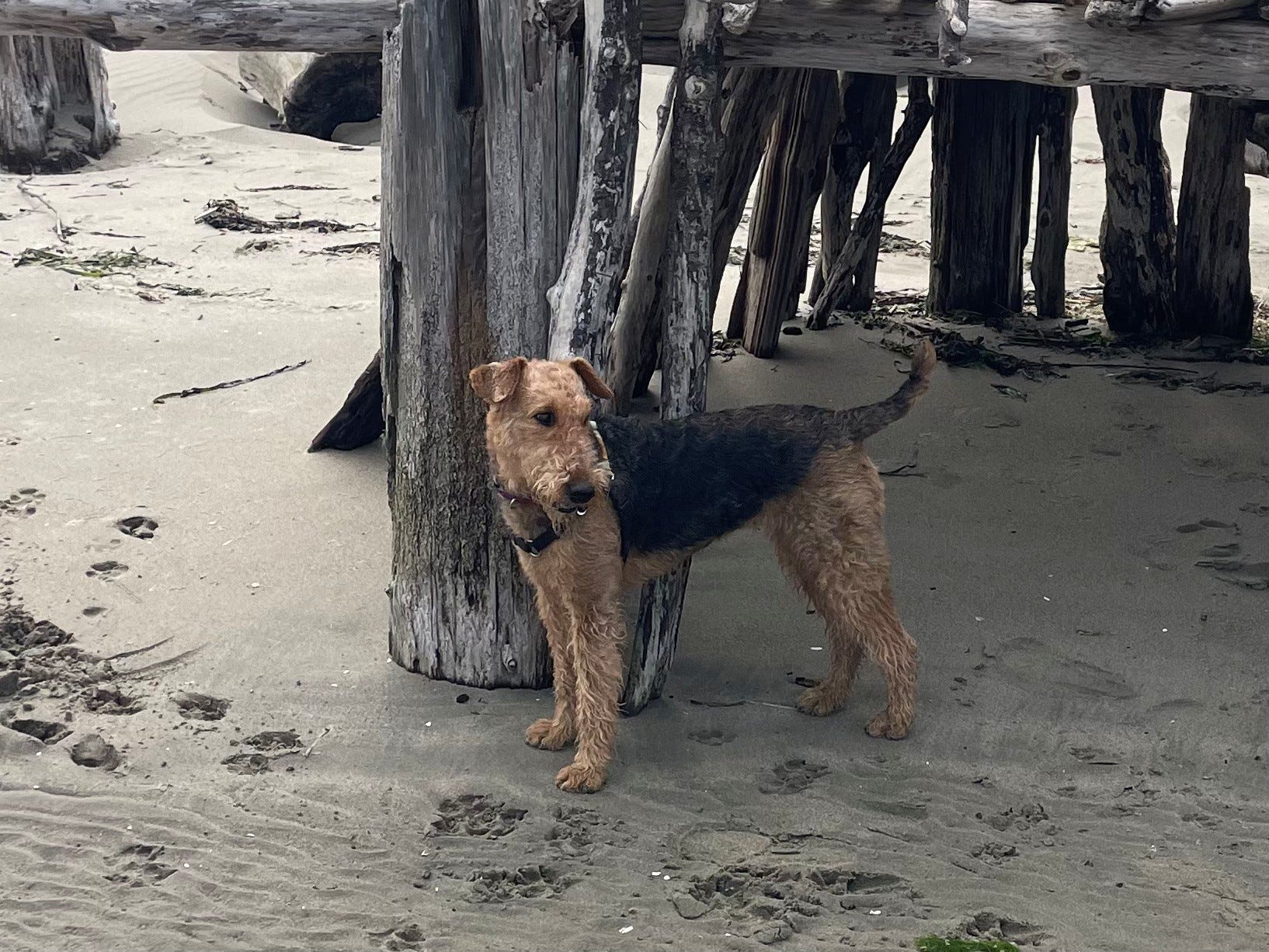
Since Rosie came into his life, Henry Johnson has in typical Looser Island fashion brought his dog with him everywhere, including to his office, where she generously acts as therapy dog to every frightened child and weary adult who walks through the door.
There is one, and only one, exception. Henry never brings Rosie with him when he goes to the ruins. The space is too sacred to risk defiling with dog pee or a violent squirrel chase. Also, Rosie is a post-Mary addition, deposited in his home by a well-meaning islander who thought it might help the good doctor “get over” the loss of his wife. Henry goes to the ruins to visit Mary; Rosie, who never met Mary, doesn’t belong in that setting.
After Mary’s death, Henry paced and prowled the island from end to end, looking for some surcease to his grief. In addition to the cliffs looking out to sea, and the rocky patches of public beach where safe navigation required the full engagement of his brain to avoid falling, he often found himself on the path to the ruins. He’d make his way through the deepening silence and, after checking that there was no one else around, he’d sit in one of the stone chairs, and close his eyes. If he was lucky, Mary’s ghost—whether real or imagined, it didn’t seem to matter—would drift in from the cemetery down the road. She’d sit in one of the other chairs, and smile at him, and sometimes she’d reach over and rest her insubstantial hand on his.
He wasn’t exactly young when cancer took her, but in the intervening span he’d aged more than just eleven revolutions around the sun. Over the years, his hand on the stone table grew wrinkled and age-spotted, and the hair on his knuckles turned gray.
Mary was fifty-one when she passed, age starting to catch up to her, as it does with everyone. If she’d lived, her hands would have been their own testament to time.
But at the stone table, her skin is always smooth, and young. Here, her face and neck and hands are those of the woman Henry’d met at a party at a mutual friend’s house, decades ago.
There is music, and then there is Purple Rain.
While he was still a medical resident, Henry attended a party at a friend’s house in a rare moment of being young and human instead of only and always a doctor-in-training. Sitting on a torn and faded blue sofa was a young woman who introduced herself as Mary. Henry sat down next to her, clutching a napkin wrapped around pretzels and apple slices (as if the party had been thrown for a kindergarten class), and, incongruously, a pot brownie.
From his seat on the corner of the couch he swayed in time to the beat, and Mary told him, practically shouting to be heard over the nearby speaker, that she liked the song, just as Purple Rain was reaching its magnificent crescendo.
At least, it sounded like she said Isn’t this music great?
It might have been: Isn’t the muse a plate?
Nothing profound, in other words, unless positing the identity of a muse counts.
But he was smitten, and then, more quickly than he would have imagined possible, deeply, irrevocably, in love.
Poll Results and Reminders
The initial poll results are in: most readers still favor short episodes, and prefer my quirky and imperfect recordings. The poll is open “perpetually” if you’d like to weigh in, but I promise I won’t ask again!
Find links to the Episodes in order in the Table of Contents here (new episodes added within a day or two of posting), and the Cast of Characters here. Episode links and Cast of Characters are also available on The Dogs of Looser Island website www.alaughingdog.com.
© Shari Lane 2026 All Rights Reserved
Mary personified charmingly unpredictable. She reveled in the non sequitur, especially if the non part of it was fanciful. When Henry first met her, Mary was the Children’s Librarian at one of the Seattle public libraries, to the lasting delight of her patrons. The children who attended story hour, high school interns just learning the ropes, and young parents looking for a good book about the Terrible Twos—everyone adored her. Mary was not just loved but practically revered, in part because her blithe spirit loved nothing more than whimsy.
“Honey, the little apple tree in the garden is disappointed,” she once told him, during their first year on Looser Island.
“Why, what have I done now?”
“Yesterday, you left the house without kissing me goodbye,” Mary said.
“How does the little apple tree know I failed to kiss you goodbye yesterday?” he asked.
“I told her, of course,” Mary said, raising an eyebrow.
He made sure to kiss her goodbye the next morning, and every morning thereafter, until the day she said goodbye first, and left him forever.
After every trip to the ruins, Henry went home and had a whisky, neat.
Just one.
He knew the danger of trying to drown one’s sorrows in alcohol, having diagnosed it many times in his patients, so he kept it to a single glass.
He’d stand at the window of the elegant dining room, a room that would be musty and creaking with disuse if the housecleaner didn’t dust and vacuum it every week. With Rosie sitting or lying at his feet, he’d sip his whisky, and look out over the Salish Sea. Standing at that window, he’d seen violent sunsets, the clouds an angry bruised purple streaked with crimson, as if the sun was bleeding. And he’d seen tender sunsets, the sun laying a golden path on waters the hue and consistency of molten silver—“Inspirational poster scenes,” Mary used to call them. And ridiculously cheery sunsets, white clouds on blue sky like a child’s art project made with cotton balls and tempera paints, the setting sun presiding over jaunty white-capped waves plied by even jauntier sailboats, all painted in soft corals and pinks, a gentle goodnight to the islanders.
He never wearied of the view. Through all the stages of mourning, his time looking through that window always brought respite, if only briefly.
Just before leaving the dining room to give Rosie her dinner, Henry would touch the fairy tile in the corner of the built-in china cabinet.
For luck.
“I want a fairy tile.”
“But honey . . . .” Patience and impatience wrestled in his voice. Patience won. “We’ve already picked a northwest lodge motif for the house, and we’ve told the contractor how we want the dining room to look. You said this is what you wanted. We’ll have green tiles and brown tiles, and a few pine trees, for accent. A fairy . . . won’t fit in.”
“You’re right,” Mary said. “But we can hide it. We can put it in the corner at the end of where the built-in will be. It’d be covered by your grandmother’s china. No one would ever see it.”
“Then why have it?” Henry said. “If no one will know it’s there?”
“I’ll know,” Mary said, flashing an impish look at him. “There’ll be a fairy in a hidden corner of my dining room, and the thought will make me happy. Even more happy,” she added, “because it will be my secret.”
The local artist they’d hired to make the tiles pursed his lips at the request. Later, it turned out his talent vis-à-vis a specific image was pretty much limited to pine trees. The fairy looked less like Tinkerbell and more like a misshapen garden gnome that had been used as a soccer ball stand-in. But it was there and it delighted Mary.
After the house was finished, Mary would sometimes stand in the dining room just before dinner guests arrived. She’d look with pleasure at the cherry dining table and chairs, the leaded-glass doors to the built-ins housing a motley mix of china (from two sets of grandparents with wildly different tastes), and the warm wood wainscotting topped by a row of clay tiles, plain tiles interspersed with the occasional pine tree. Just before leaving the room to greet their guests, she’d touch the hidden fairy tile, and she’d smile.
Meet me here next week for Blue Eyed Marys.
I think I would also like to have a hidden fairy tile.
Oh, now I think we need a fairy tile too! 🧚♂️💜