


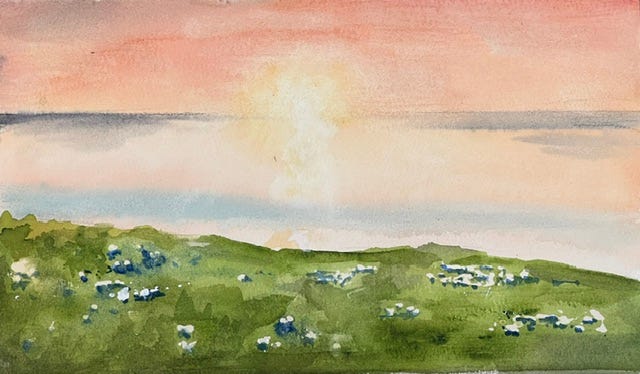
At some point, Henry stopped touching the fairy tile Mary loved so much. He no longer believed in luck. Not good luck, anyway. Not for him.
And he stopped visiting the ruins. Maybe it was an almost subconscious realization that the Looser Island community needed him to be a stable point around which their madness could whirl and dervish, an acknowledgment that the island’s doctor should be grounded, not given to flights of fancy—or communing with ghosts—to free everyone else to be as harebrained or frivolous as the situation demanded.
Or maybe it was just too painful to see the youthful ghost sitting beside him at the stone table, only to have to give her up when it was time to leave.
Again.
Reminders: Find links to the Episodes in order in the Table of Contents here (new episodes added within a day or two of posting), and the Cast of Characters here. Episode links and Cast of Characters are also available on The Dogs of Looser Island website www.alaughingdog.com.
© Shari Lane 2026 All Rights Reserved
After Missy leaves the clinic, Dr. Johnson tells Genevieve he’s taking the afternoon off. He has no patients scheduled, he reminds her, and he says he’s not feeling well.
“You’re going to the ruins, aren’t you?” she says. “I heard what Missy said. You figure if Missy saw a ghost maybe you will too.”
He shakes his head, but it’s a lie, this head-shaking.
“Don’t do it, Doc. No good can come of trying to call up ghosts.”
“I just need to rest,” he says.
When he arrives, he parks in the unmarked cutout on the side of the road. The ubiquitous rain has stopped, and an unexpected sunbreak dapples the forest floor with light. The effect is dizzying. As he moves deeper into the forest, closer to the ruins, the sun is shut out altogether, and it’s a relief to walk in the gloaming. He notices, as he has so many times before, how his steps on the wet and pungent pine-needled path are silent.
The ruins are not far from Ronwen and Nash’s place. (No place is far from any other place, on a small island, but the ruins are especially close, situated directly inland from the old cabin on the beach.) And he thinks: What if there’s some criminal connected with the wrecked boat and the dead body, wandering the woods? He wonders, briefly, what he would do if he met the proverbial “bad guy,” but almost immediately he knows; he’d put up no fight, just let the criminal do his or her or their worst.
At the site, the sun comes through again, a shaft like an alien searchlight stabbing through the opening in the trees directly above the broken stone table. It should look like one of Mary’s postcard tableaus, Sunbeam in the Woods, but it only adds to the discomfiting surrealism of the scene.
He sits on the same stone chair he always used to choose, when he came here regularly, the chair opposite where the path opens onto the ruins. He tells himself he’s being stupid, he tells himself not to hope, he tells himself to shut up, stop talking, and wait for Mary.
There is a sound, the slightest whisper of a suggestion of a rustle.
Wildlife, of course. Per square foot, the human population is vastly outnumbered by mice and voles and harmless garden snakes and little birds of every shade of brown and gray and black. He sees nothing, but he knows most forest animals have evolved specifically to be invisible among the striped shadows in the foliage. Nevertheless he tenses, wondering if this time things will be different, if Mary is going to make a sound when she appears, if maybe she’ll even speak to him.
He closes his eyes, waiting, and then changes his mind, and peers out from under half-closed lids. Movement to his right. He turns his head and finds a robin—an ordinary, dull, uninteresting bird—staring at him, and then it flies away, quickly, as if it understands it has disturbed a sanctuary for spirits only. This is no place for living creatures.
She doesn’t come.
“I am an idiot,” Henry says softly. “An old, delusional idiot.”
He picks up his creaking body, already sore from the short time resting on the rough stone chair, and shuffles back down the path.
One of his patients recently turned ninety, and he still rides his bicycle everywhere, including the nearly five miles across the island from his home to the village. Henry is sixty-four, but he feels far, far older. Shuffling, creaking, fossilized. The idea of riding a bike across five miles of rolling hills seems preposterous, especially now, when he feels weary from the short walk to the car.
Just before the path opens back out to the place on the side of the road where no one is supposed to park but everyone does, he sees a patch of brilliant blue and white nestled between the roots of a tree.
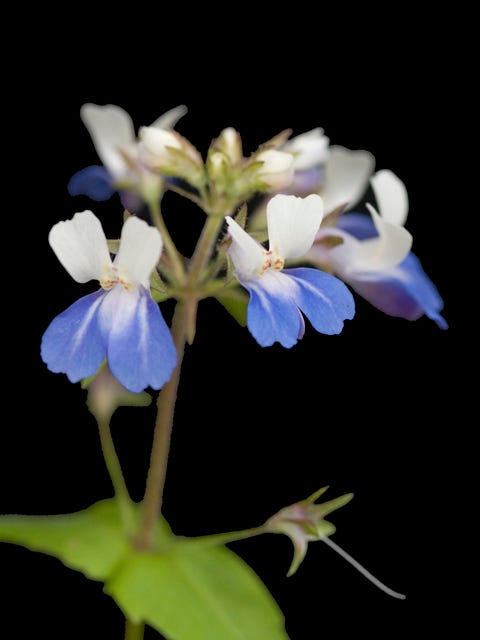
Blue Eyed Marys.
“I’ve brought you some flowers, lovey. A new one Lauren’s carrying at the Apple Cart while they’re in season: Blue Eyed Marys.”
“Henry,” Mary said, “Look at me. My eyes are brown.”
“Well,” he said. “They didn’t have any brown-eyed flowers.”
“You’re ridiculous, and I love you,” she said.
After that, finding Blue Eyed Marys on the cliffs of Hackanaw Head was an annual spring miracle the two of them sought out like pilgrims marching to touch a weeping statue. And it was always the same joke: Look, honey, there’s your flower, the Blue Eyed Mary; then Henry, my eyes are brown; and Well, there aren’t any brown-eyed flowers.
The thing is, Blue Eyed Marys bloom in the spring—Collinsia verna, the first word from the scientist who named them, the second from the Latin word for spring. Tiny soft blue and white flowers tucked among the riot of yellow and white and purple and orange, a veritable carpet of flowers dancing in the cool marine breezes that blow, nonstop, from the sea. It’s December, now. The dusty, thirsty end of summer has given way to the rain and mud and sorrowful flowerless bracken of late fall and early winter. There are no wildflowers on Looser Island in December.
Also, Henry is certain, as certain as a man blinded by grief can be, that there were no Blue Eyed Marys on the side of the path when he arrived, less than an hour ago.
On his way home that afternoon, Henry runs into Missy at the Apple Cart, and she asks in an exaggerated whisper, clutching a package of spaghetti noodles, if he has figured out if she’s crazy or not.
He starts to put his hand on her shoulder but stops, and lets his hand drop to his side. There is something about Missy that speaks of a longing for familiarity, but just now, when she thought he was going to touch her, she flinched. Maybe marrying Jenny will help, he thinks. (He’s heard the rumors of a wedding “someday,” though he didn’t get a chance to ask Missy about it when she was in his office earlier that day.) Or maybe it’s too late for Missy to ever assume human touch is a kindness and not a threat.
“I don’t think you’re crazy,” he says, suppressing a sigh.
Eli and Ronwen are standing in the same aisle, perusing the pasta options. This is the second time he’s seen Eli and Ronwen apparently together in the Apple Cart, and he wonders if there’s something to it, some late-life romance blooming between widow and widower. A tide of bitterness sweeps over him. Even if dating was an option (it’s not, since pretty much every woman on the island is also a patient), he doesn’t want a new romantic partner. He wants Mary.
“Now Missy,” Eli says, in a grandfatherly tone, “Why would you think you’re crazy?”
It is an unwritten rule on the island that anything overheard at the Apple Cart is fair game. This seems to be the prevailing philosophy: if you don’t want someone to overhear, and comment, don’t say it out loud in a small island grocery store.
Missy doesn’t tell Eli what she’d told Dr. Johnson earlier, that she and Jenny saw a ghost at the ruins. Instead, she jokes, “It’s okay. Jenny says she loves that I’m cray-cray.” She chortles and adds, “Mad Mad Missy, that’s me!”
Henry does not join in the communal smile. Instead, he takes his organic apples and carrots to the checkstand, hoping his sadness won’t infect everyone else in the store. Or hoping it will.
What right has everyone else to be happy?
As if pain really was contagious, the next day Genevieve’s long lost lover is found. The lover is promptly lost again, and then Dr. Johnson’s stolid, staid, middle-aged nursing assistant does her best impression of a lovelorn adolescent, moping and hiding and crying. How her employer knows about the ordeal is somewhat of a mystery, even to himself—though no more so than usual; island gossip seems to float or fly on the very winds of the Salish Sea. He considers what a good friend would do and, finding no answers within, he gives Genevieve a week to mourn, after which he tells her it’s time to get back to work.
If only there was someone who would say the same to him.
In sympathy with Genevieve, Henry finds his sorrow refreshed, a hellish renewal of a library book he never wanted in the first place. After Genevieve returns to work, he repeatedly asks her to cancel his appointments, tells her he’s sick. Or sick at heart. Even as winter settles on the island, and the weather fixes on miserable as its default, he makes his way regularly to the broken table where his wife’s ghost used to sit with him.
She never shows.
“Who’s the crazy one now?” he shouts into the dripping, perpetual twilight. “Loony. Loco. Insane!”
He tries to remain engaged, to keep busy. In January, he forces himself to stop by the re-roofing project for Ronwen and Nash’s cabin, to joke about the fact that the only way to make sure no one gets hurt is to have a doctor around.
But he doesn’t really believe that. In addition to his own losses, his professional life has been one long litany of other people’s injuries and illnesses. He’s been the source, though not the cause, of so much pain. The irony is inescapable, for a man whose mission and mantra and code is: First do no harm.
Simply being present is neither deterrent nor cure for anything, it turns out.
Meet me here next week when the doctor determines Missy’s not crazy.
Charming and delightful, as always.